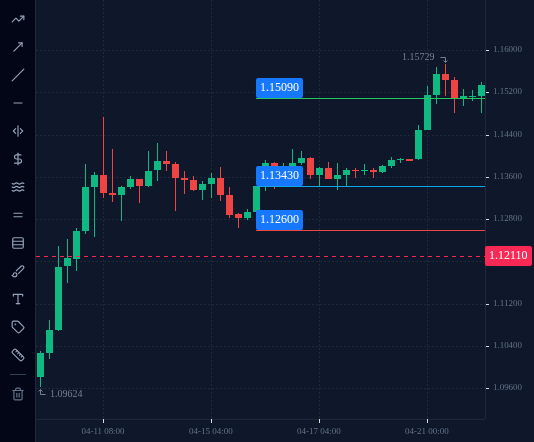
Fear of missing out makes traders chase entries; fear of losing makes them cut winners early and widen stops on losers. Each one quietly changes the numbers your plan was built on.
In this lesson you see, on a real EURUSD trade, how chasing an entry, cutting a winner and widening
a stop each change the numbers, and how to find these habits in your journal.
1 FOMO - chasing the entry
FOMO (fear of missing out) is the urge to jump in after price has already moved, because it
feels like the move is leaving without you.
Take the EURUSD H4 trade from lesson 1.5. The plan entry was 1.1343 (close of the 16 April
2025 00:00 UTC candle), stop 1.1260, target 1.1509.
Now imagine a trader who missed it and buys at 1.1387, the close of the next (04:00 UTC)
candle, keeping the same stop and target:
Risk: 1.1387 − 1.1260 = 127 pips (the plan had 83)
Reward: 1.1509 − 1.1387 = 122 pips (the plan had 166)
Reward ÷ risk = 122 ÷ 127 = 0.96, worse than 1:1
Same chart, same levels, a much worse trade. Chasing does not just feel rushed; it changes the
maths. If the entry is gone, the trade is gone.
The same trade went sideways for a few days. A nervous trader might close at 1.1364, the
close of the 17 April 2025 00:00 UTC candle, afraid the small profit would vanish. (Later that
day, on the 12:00 UTC candle, price did dip as low as 1.1335, but it never reached the stop.)
Profit: 1.1364 − 1.1343 = 21 pips
In R: 21 ÷ 83 = 0.25R
The planned target, 1.1509, was reached on 21 April: +2R. One early exit gave away
1.75R.
Lesson 11.3 showed that expectancy depends on the size of the average win. If fear keeps
shrinking your wins while your losses stay at −1R, a plan that worked on paper stops working in
your hands. Early exits are allowed only when your plan has a rule for them.
Quick check
3 Hope - widening the stop
The opposite fear: a trade heads for the stop and you move the stop further away, “to give it
room”. This is the most expensive habit in this lesson.
Example: 0.10 lot of EURUSD (US$1 per pip), stop 20 pips away, so you risk $20. You move
the stop to 40 pips. If it is hit, you lose 40 × $1 = $40, which is 2R, not the 1R your
plan allowed.
Moving a stop closer to lock in profit can be part of a plan. Moving it further away never
is (lesson 1.2).
Quick check
4 Catch it in your journal
These habits leave footprints:
Chasing: entries far from the level your plan names, and R:R below what the plan requires.
Cutting winners: many small wins well below your planned target.
Widening stops: losses bigger than −1R.
Every week, look for these three in your journal. When you find one, write which rule was
broken and how you felt just before (lesson 11.2).
0 of 4 questions right. Answer them all to complete the lesson.