Your lot size is not a guess. It comes from three numbers you already have, your risk in money, your stop in pips and the pip value, so every trade risks the same share of your account.
In this lesson you turn the 1% rule into a lot size. One formula, three numbers, and a check in the
order ticket.
1 Lots and pip value
Forex positions are measured in lots. One standard lot is 100,000 units of the base currency.
1.00 lot = 100,000 units (standard lot)
0.10 lot = 10,000 units (mini lot)
0.01 lot = 1,000 units (micro lot)
On EURUSD a pip is 0.0001. One pip on 1.00 lot is worth US$10, because
100,000 × 0.0001 = 10. So 0.10 lot is worth $1 a pip and 0.01 lot is worth $0.10 a pip.
Other pairs differ. On USDJPY a pip is 0.01, and one pip on 1.00 lot is 1,000 yen, so its value
in dollars depends on the price. This lesson uses EURUSD to keep the numbers clean.
2 The formula
Lot size = risk in money ÷ (stop in pips × pip value per lot)
Example: a $1,000 account, 1% risk, a 25-pip stop on EURUSD.
Risk in money: $1,000 × 1% = $10.
Cost of the stop on 1.00 lot: 25 pips × $10 = $250.
Lot size: $10 ÷ $250 = 0.04 lot.
Check: 0.04 lot is worth $0.40 a pip. 25 pips × $0.40 = $10. That is exactly 1%.
Quick check
3 Wide stop, small size
The stop goes where the idea is proven wrong (lesson 1.2). You do not shrink the stop to fit a
bigger position. You shrink the position to fit the stop.
Same $1,000 account, same $10 risk, but a 50-pip stop:
50 × $10 = $500 per lot, and $10 ÷ $500 = 0.02 lot.
Double the stop, half the size, same money at risk.
Terminals let you trade in steps of 0.01 lot. If the answer falls between two steps, round
down, so you never risk more than you planned. Example: $5,000 account, 1% risk ($50),
40-pip stop: $50 ÷ (40 × $10) = 0.125, so you trade 0.12 lot and risk $48.
Do the sum on paper first. Then open the order ticket on EURUSD, enter your volume in Lots and
your stop-loss distance in pips, and compare.
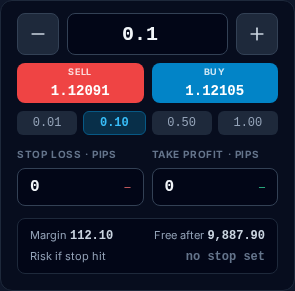
The ticket’s “Risk if stop hit” line shows how much money the trade loses at the stop, and what
share of your equity that is. That number should match your risk in money. If it does not, find
out why before you send the order: usually the stop distance or the volume was typed wrong.
The practice terminal's EURUSD order ticket, signed in to a new practice account (staging, 16 Oct 2026; prices are the feed at capture time): Lots at 0.1, STOP LOSS · PIPS and TAKE PROFIT · PIPS still at 0, and the Risk if stop hit line reading "no stop set" until a stop distance is entered.
Open this in the terminal
↗(opens in a new tab)
Check your understanding
0 of 4 questions right. Answer them all to complete the lesson.