Risk a fixed small percentage of your account on every trade, often 1%. A run of losses then costs you a little, not everything.
In this lesson you learn the 1% rule: a fixed, small amount of risk on every trade, worked out from
your equity.
1 What the rule says
Before each trade, decide how much money you will lose if the stop is hit. That amount is
your risk. The 1% rule says: make it no more than 1% of your account.
Account
1% risk per trade
$500
$5
$1,000
$10
$10,000
$100
Risk is not the size of the position. It is the money you lose if the trade goes to your stop.
Quick check
2 Why such a small number
Every trader has losing streaks. The rule makes sure a streak is survivable.
Example with $1,000 and ten losing trades in a row:
Risking 1% each time, the account ends near $904 (about −9.6%). You need about +10.6% to recover.
Risking 10% each time, the account ends near $349 (about −65%). You need about +187% to recover.
Working for the 1% case: each loss leaves 99% of what was there, so $1,000 × 0.99¹⁰ ≈ $904.
For 10%: $1,000 × 0.90¹⁰ ≈ $349.
Same trades, same entries. Only the risk per trade changed.
3 Use equity, and let the number move
Work out 1% from your equity (lesson 1.1), not from the balance you started with.
After losses, 1% is a smaller amount, so you automatically risk less while you are losing.
After gains, 1% grows with the account.
Example: you start with $2,000, so 1% is $20. After some losses your equity is $1,800. Now 1% is
$18.
Some traders use less than 1%, such as 0.5%. The point is a small, fixed percentage that you
apply to every single trade.
Quick check
4 Find your number in the terminal
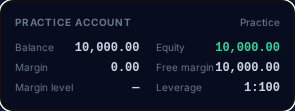
Open the account panel in the practice terminal and read your equity. Multiply it by 0.01. That
is the most you should lose on your next trade.
Write the number down before you open the order ticket. Lesson 1.4 turns it into a lot size.
The practice terminal's account panel for a new practice account with no trades (staging, 16 Oct 2026): Balance and Equity both 10,000.00, Margin 0.00, Free margin 10,000.00, Margin level — and Leverage 1:100.
Open this in the terminal
↗(opens in a new tab)
0 of 3 questions right. Answer them all to complete the lesson.