Leverage lets you open a position much bigger than your balance by locking up only part of its value as margin. It does not change what a pip is worth, but it lets you open trades big enough to wipe out the account.
In this lesson you learn what leverage and margin are, how to read balance, equity and free
margin, and how an account gets to a margin call and a stop out.
1 Margin is a deposit, not a fee
To open a position you do not pay its full value. The broker locks a small part of your
money as a deposit, called margin. You get it back when the trade closes.
Leverage says how small that deposit is. At 1:100, the margin is one hundredth of the
position’s value.
Example: buy 0.10 lot of EUR/USD at 1.16000.
Position value: 10,000 euros × 1.16000 = US$11,600
Margin at 1:100: 11,600 ÷ 100 = US$116
Quick check
2 What leverage really does
Leverage does not change what a pip is worth. On 0.10 lot of EUR/USD a pip is US$1 at
1:30, at 1:100 or at 1:500. Lesson 0.4 still holds.
What leverage changes is how big a position you are allowed to open with the money you
have. With US$1,000 at 1:100 you could open up to about 0.86 lot of EUR/USD at 1.16000
(0.86 × 100,000 × 1.16000 ÷ 100 = US$997.60 of margin). Each pip on that would be worth
US$8.60, so a 100-pip move against it would lose US$860, most of the account.
Leverage is not the risk. The position size it allows is.
Quick check
3 Balance, equity, free margin, margin level
Four numbers describe the account while a trade is open:
Balance: money in the account, not counting open trades.
Equity: balance plus the profit or loss on open trades right now.
Free margin: equity minus the margin in use. This is what is left for new trades and
for absorbing losses.
Margin level: equity ÷ margin × 100%.
Example: balance US$1,000, the 0.10 lot trade above (margin US$116) is 50 pips down, so
−50 × US$1 = −US$50.
When losses push the margin level down, two things happen. These levels are set by each
broker; this lesson uses 100% and 50% as example numbers.
Margin call (here 100%): equity has fallen to the margin in use. You get a warning and
may not be able to open new trades.
Stop out (here 50%): the platform starts closing your trades for you to limit
further losses. You do not choose the price.
Same US$1,000 account, but 0.80 lot of EUR/USD at 1.16000. Margin = 0.80 × 100,000 ×
1.16000 ÷ 100 = US$928, and a pip is worth US$8. Stop out comes when equity falls to 50% of
US$928 = US$464, that is after a loss of 1,000 − 464 = US$536, or 536 ÷ 8 = 67 pips.
With 0.10 lot the same account could take a loss of 1,000 − 58 = US$942, or 942 pips.
Quick check
5 In the terminal: read the account panel
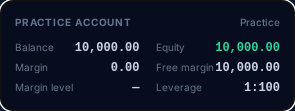
Open the account panel in the practice terminal. With no trades open, balance and equity
are the same and no margin is in use.
Find balance, equity, margin and free margin. In the next lesson you will open a small
trade; come back here afterwards and watch equity and free margin move with the price while
balance stays still until the trade is closed.
The practice terminal's account panel for a new practice account with no trades (staging, 16 Oct 2026): Balance and Equity both 10,000.00, Margin 0.00, Free margin 10,000.00, Margin level — and Leverage 1:100.
Open this in the terminal
↗(opens in a new tab)
0 of 3 questions right. Answer them all to complete the lesson.