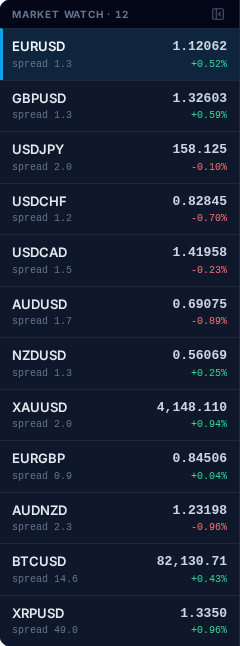
Every pair has two prices at once, a bid and an ask. The gap between them is the spread, and it is a cost you pay on every trade.
In this lesson you learn why a pair always shows two prices, how to measure the gap between them
in pips, and why that gap is the first cost of every trade.
1 Two prices, not one
In lesson 0.1 a pair had one price. In a trading platform it always has two:
The bid is the price you can sell at.
The ask is the price you can buy at.
The ask is always a little higher than the bid. The dealer on the other side of your trade
buys from you a little lower and sells to you a little higher.
These are example numbers, not a live quote: EUR/USD bid 1.16100, ask 1.16112. If you sell,
you sell at 1.16100. If you buy, you pay 1.16112.
Quick check
2 The spread is the gap
The spread is the ask minus the bid. Using the example above:
1.16112 − 1.16100 = 0.00012
Spreads are usually counted in pips. On EUR/USD one pip is 0.0001, the fourth decimal
place (lesson 0.3 covers pips properly). So:
0.00012 ÷ 0.0001 = 1.2 pips
The fifth decimal is a tenth of a pip. That is why many quotes show five decimals.
Quick check
3 The spread is a cost
Say you buy at the ask, 1.16112, and close the trade straight away. Closing a buy means
selling, so you sell at the bid, 1.16100. The price did not move, but you are 1.2 pips down.
Every trade starts with that small loss. The price has to move in your favour by the
spread before the trade breaks even. The same is true for a sell: you sell at the bid and
close by buying at the ask.
Spreads are not fixed. They differ between pairs and between brokers, and they often widen
when trading is thin (for example around the daily rollover) or when big news is released.
Quick check
4 In the terminal: watch the spread live
Open the practice terminal and look at the Market Watch panel. Each symbol shows its bid
and its spread in pips, and both change several times a second while the market is open.
The ask is on the order ticket: the SELL button shows the bid and the BUY button shows the
ask (on a phone, the strip above the chart shows bid, spread and ask together).
Pick EURUSD. Note the bid and the ask, subtract one from the other, and convert the gap to
pips. Check your answer against the spread Market Watch lists. Do it again a minute later.
Then compare it with a less traded pair in the list: its spread will usually be wider.